


How to Choose a Lithium Battery Pack for Floor Cleaning Machines
Choosing a lithium battery pack for floor scrubbers, sweepers, and industrial cleaning machines is not only about voltage and capacity. OEMs must also confirm load profile, BMS current rating, charger matching, battery compartment size, wiring harness design, connectors, enclosure structure, and long-term service requirements.
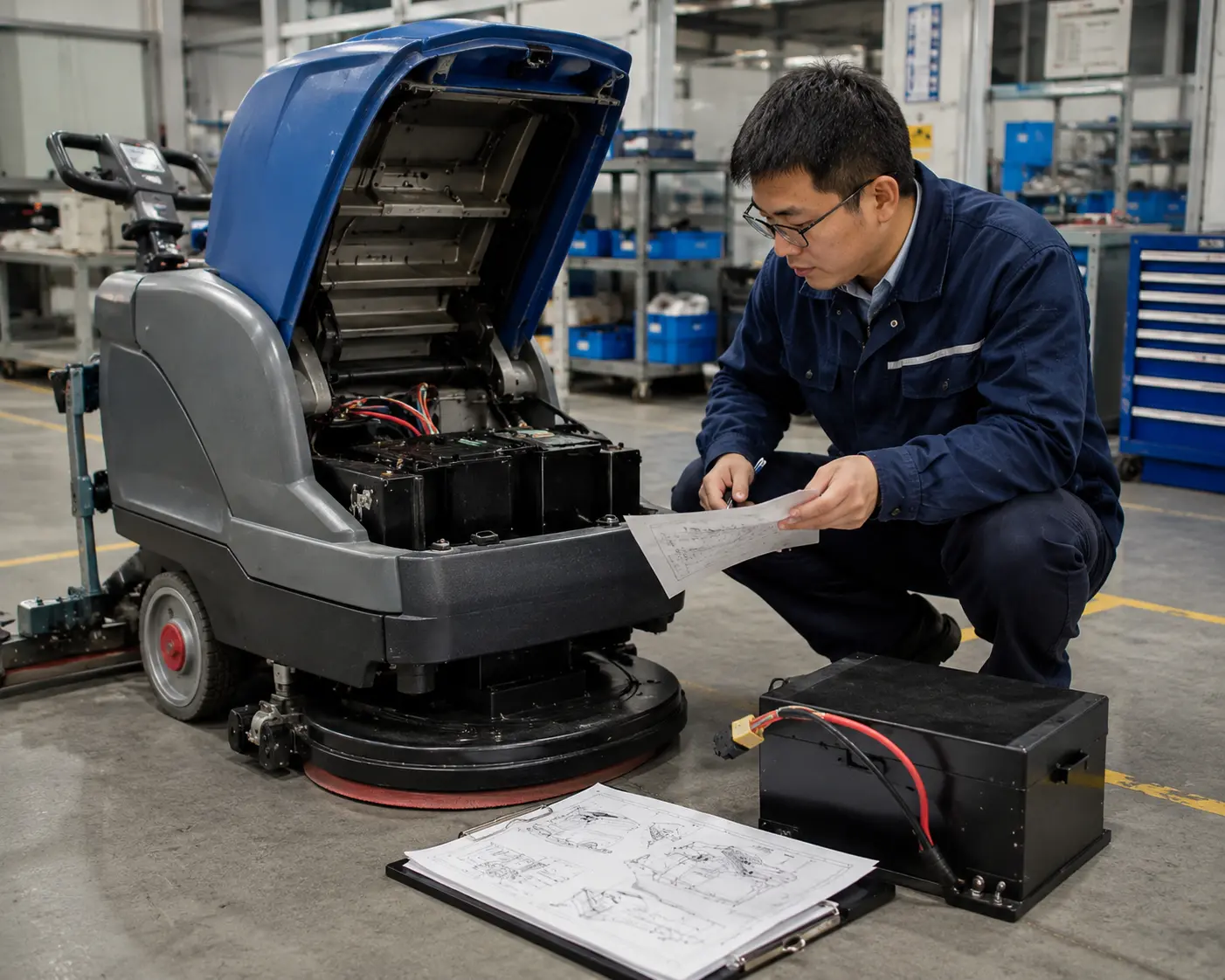
Why Lithium Battery Selection Needs an OEM Design Approach
Floor cleaning machines are used in warehouses, supermarkets, hospitals, shopping malls, factories, airports, schools, and public facilities. These machines usually operate on fixed cleaning schedules, so battery reliability directly affects machine availability and customer satisfaction.
A LiFePO4 battery pack can help cleaning equipment improve charging efficiency, reduce maintenance, lower service downtime, and provide more stable power output than traditional lead-acid batteries. However, a lithium upgrade should not be treated as a simple battery replacement. The battery pack must be matched to the machine platform.
Chalongfly provides custom motive power battery solutions for OEM industrial equipment, including dedicated LiFePO4 battery packs for floor cleaning machines.
Step-by-Step Checklist for Choosing a Lithium Battery Pack
For OEM floor cleaning equipment, the best battery choice is based on a complete system checklist. The following steps help reduce redesign risk and make the battery pack easier to test, install, and scale into mass production.
Confirm the Machine Voltage Platform
Most floor scrubbers and sweepers use 24V, 36V, or 48V battery systems. The correct voltage depends on the motor power, controller design, charger system, and existing equipment platform. For a new OEM machine, voltage should be selected together with motor and controller requirements.
Define Runtime and Capacity Requirements
Battery capacity should be calculated from the expected working hours, brush motor power, vacuum motor power, traction motor load, pump load, and duty cycle. A machine used for short daily cleaning may need a different capacity from a ride-on scrubber used across multiple shifts.
Check Continuous and Peak Current
Floor cleaning machines can have high startup current when brush motors, vacuum motors, and drive motors operate together. The BMS must support both continuous discharge current and short peak current without nuisance protection shutdowns.
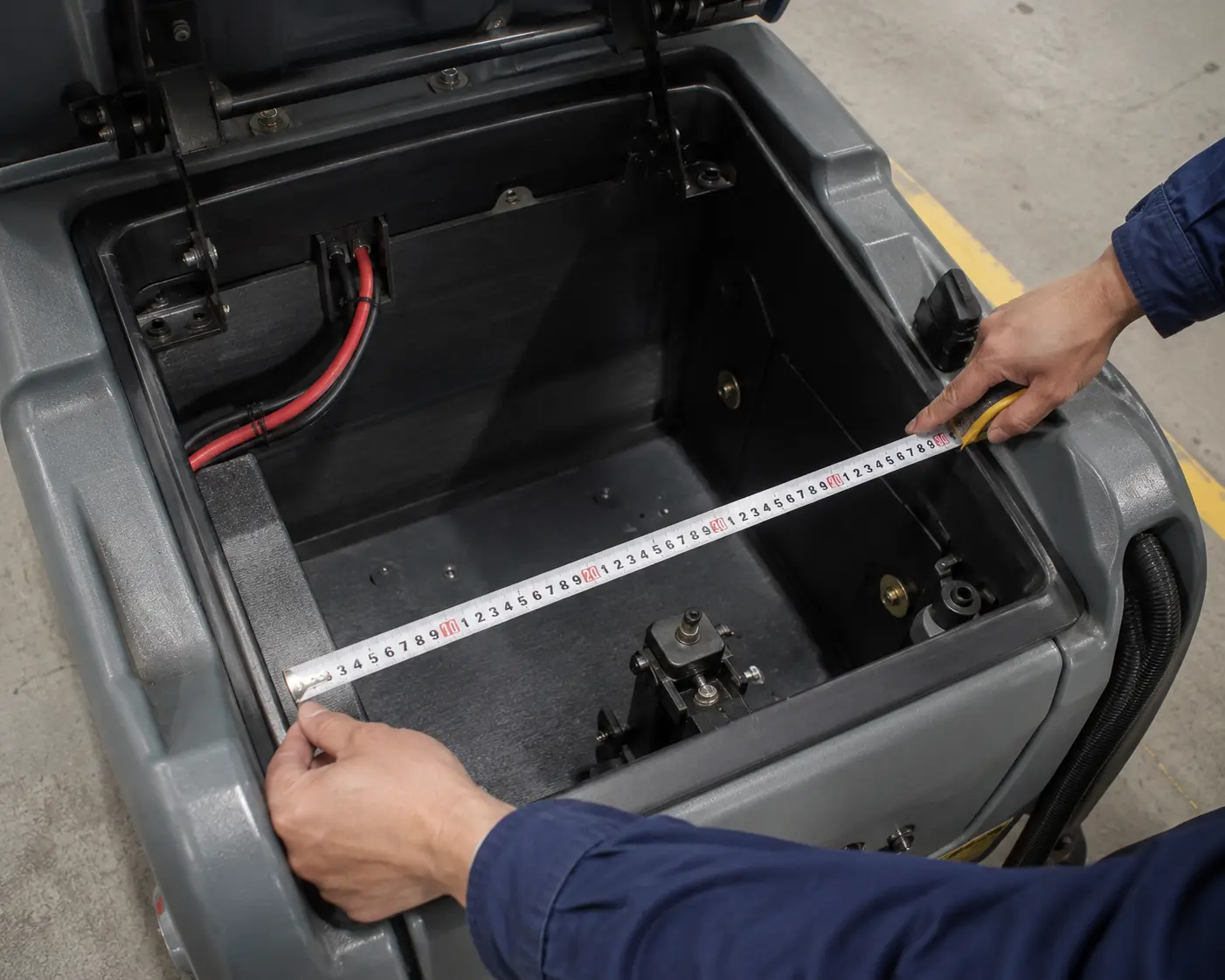
Measure the Battery Compartment
The available space, mounting points, cover clearance, cable outlet direction, ventilation space, and replacement method must be checked before pack structure design. For OEM projects, 2D or 3D drawings are strongly recommended.
Match Charger and Charging Profile
LiFePO4 batteries should use a charger with a suitable lithium charging profile. Charging voltage, charging current, connector type, charge port position, and communication requirements should be confirmed before sample production.
Design BMS, Harness, Connectors, and Enclosure Together
A reliable battery system includes cells, BMS, wiring harness, power connectors, signal connectors, fuse or protection design, enclosure material, cable outlet protection, labeling, and service logic. These items should be designed as one integrated system.
Key Specification Factors OEMs Should Compare
| Selection Factor | What to Confirm | Why It Matters | OEM Recommendation |
|---|---|---|---|
| Voltage | 24V / 36V / 48V Match the motor controller and equipment platform. |
Incorrect voltage can damage components or reduce machine performance. | Confirm voltage before capacity and enclosure design. |
| Capacity | Battery Ah or Wh/kWh based on runtime target and load profile. | Capacity affects working time, battery size, weight, and cost. | Use real machine load data when available. |
| BMS Current | Continuous discharge, peak discharge, charge current, and protection settings. | Undersized BMS may shut down during motor startup or heavy cleaning loads. | Select BMS based on real peak load, not only average current. |
| Battery Compartment | Length, width, height, fixing points, cover clearance, and cable outlet direction. | Good fitment reduces installation difficulty and service problems. | Provide drawings or measurement photos before sample design. |
| Connectors | Power connector, charging connector, signal connector, and service connector. | Connector choice affects safety, maintenance, assembly speed, and compatibility. | Standardize connector layout for mass production models. |
| Charger Matching | Charge voltage, charging current, charging profile, connector type, and communication. | Wrong charging settings can shorten battery life or trigger protection faults. | Test charger and battery pack together during sample validation. |
| Communication | CANBus, RS485, UART, Bluetooth, or simple signal output if required. | Smart monitoring can help OEMs display SOC, faults, and battery status. | Define communication protocol early if the machine has a display or controller interface. |
| Enclosure | Plastic case, steel case, IP protection, handles, brackets, and service access. | Enclosure affects safety, durability, assembly, and field maintenance. | Choose enclosure according to vibration, moisture, cleaning chemicals, and installation method. |
Battery Pack Design for Different Floor Cleaning Machines
Walk-Behind Floor Scrubbers
Walk-behind scrubbers usually require compact battery packs, easy replacement, reliable cable routing, and stable runtime for supermarkets, workshops, hospitals, and commercial buildings.
- Compact battery size
- Simple charging access
- Low maintenance operation
- Reliable connectors and cable outlet
Ride-On Scrubbers and Sweepers
Ride-on machines often require larger capacity, higher discharge current, stronger enclosure design, and more careful BMS current matching because traction, brush, and vacuum loads may operate together.
- Higher capacity battery pack
- Higher continuous and peak current
- Robust enclosure and mounting design
- Optional communication with machine controller
BMS and Wiring Harness Integration Should Not Be Ignored
A LiFePO4 battery pack for floor cleaning equipment needs more than cells and a case. The BMS controls over-charge, over-discharge, over-current, short-circuit, temperature protection, balancing, and sometimes communication with the machine controller. If the BMS is not matched correctly, the machine may stop during high-load operation or fail to charge properly.
Wiring harness design is also important. Floor cleaning machines may have power cables, charging cables, signal wires, display wires, temperature sensing, communication lines, and service connectors. Poor cable layout can create installation difficulty, service risk, and long-term reliability problems.
Chalongfly can support related battery wiring harness and custom cable assembly integration for OEM battery pack projects.
Recommended Information to Provide Before Quotation
The more complete the project information, the faster the battery manufacturer can evaluate feasibility, cost, sample design, and production risk. OEMs should prepare the following information before requesting a custom LiFePO4 battery pack.
Common Mistakes When Choosing Floor Scrubber Lithium Batteries
Many battery problems come from incomplete early-stage selection. The following mistakes are common in floor cleaning machine lithium battery projects:
- Choosing only by voltage and Ah without checking peak current.
- Ignoring charger compatibility and lithium charging profile.
- Using a battery size that fits the space but leaves no room for cable outlet or service access.
- Underestimating brush motor, vacuum motor, and traction motor startup current.
- Using connectors that are difficult to assemble or not suitable for repeated maintenance.
- Not confirming BMS communication requirements before sample production.
- Testing the battery separately instead of testing battery, charger, controller, and machine together.
Why Work With a Custom LiFePO4 Battery Pack Manufacturer?
Standard battery models may work for simple replacement projects, but OEM cleaning equipment often needs a battery pack designed around the machine structure. A custom battery pack can help optimize capacity, enclosure, cable routing, connector position, BMS current, communication, labeling, and service process.
For equipment manufacturers, this reduces installation risk and makes the battery easier to integrate into production. It can also help create a more professional lithium upgrade package for end users.
Need a Custom Lithium Battery Pack for Floor Cleaning Machines?
Chalongfly supports OEM/ODM LiFePO4 battery pack development for floor scrubbers, sweepers, and industrial cleaning equipment. We can assist with voltage and capacity selection, BMS configuration, battery enclosure design, charger matching, wiring harness integration, connector layout, sample testing, and mass production support.
- Custom 24V / 36V / 48V LiFePO4 battery packs
- BMS current matching and protection design
- Battery wiring harness and connector integration
- Steel or plastic enclosure design based on equipment structure
- OEM/ODM support for floor scrubber and sweeper manufacturers
FAQ: Choosing Lithium Battery Packs for Floor Cleaning Machines
What lithium battery chemistry is suitable for floor cleaning machines?
LiFePO4 is commonly recommended for floor scrubbers and sweepers because it offers good safety, long cycle life, stable voltage output, and low maintenance compared with traditional lead-acid batteries.
How do I choose the right capacity for a floor scrubber battery?
Capacity should be selected according to working hours, machine load, motor power, duty cycle, and available battery compartment space. OEMs should calculate capacity based on actual machine power consumption rather than choosing only by Ah rating.
What BMS current rating is needed for a floor cleaning machine battery?
The BMS current rating should match the machine’s continuous discharge current, peak startup current, charging current, and protection requirements. Brush motors, vacuum motors, and traction motors can create high peak loads, so peak current must be checked carefully.
Can a lead-acid floor scrubber be upgraded to a LiFePO4 battery?
Yes, but the battery voltage, physical size, charger compatibility, discharge current, connector layout, and BMS protection settings must be confirmed. For OEM projects, a custom LiFePO4 battery pack is usually the safer choice.
Can Chalongfly customize connectors and wiring harnesses for floor scrubber batteries?
Yes. Chalongfly can support power connectors, charging connectors, signal wiring, communication lines, cable outlet design, and battery wiring harness integration for custom LiFePO4 battery packs.