


How to Choose a Custom Lithium Battery Pack Manufacturer: The Ultimate OEM/ODM Guide
Choosing a custom lithium battery pack manufacturer is not only about finding a supplier that can quote a voltage and capacity. For OEM and ODM projects, the right manufacturer should understand battery chemistry, electrical design, BMS protection, connector layout, wiring harness integration, mechanical structure, testing requirements and the real working environment of the final equipment.
This guide explains what buyers should check before selecting a lithium battery pack manufacturer for custom LiFePO4 battery packs, lithium-ion battery packs, industrial battery systems and OEM battery pack development.
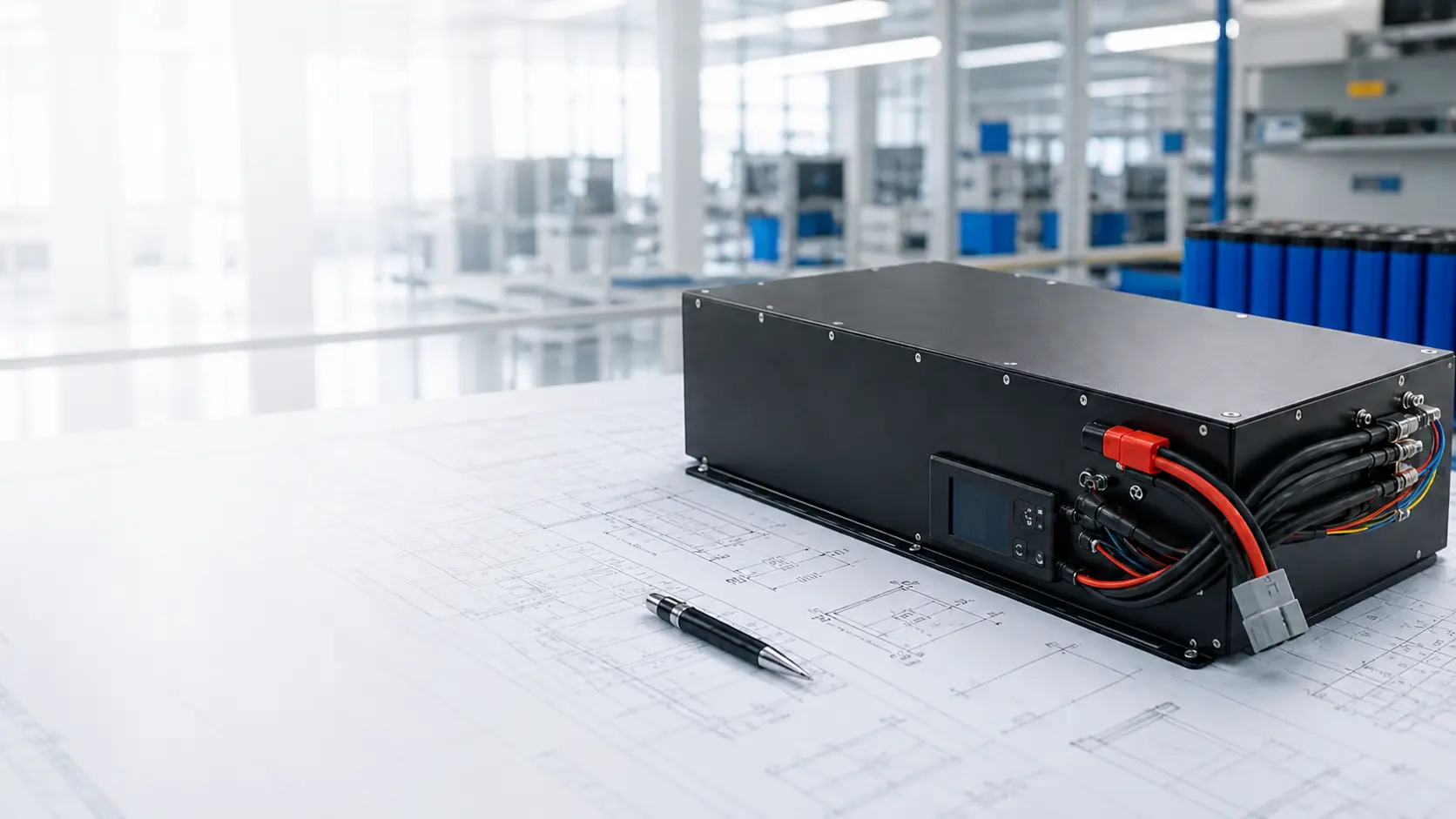
Start with the real battery application, not only voltage and capacity
Many buyers begin a battery inquiry with only a simple specification such as 48V 50Ah or 24V 100Ah. This information is useful, but it is not enough for a reliable custom battery pack design. A professional lithium battery pack manufacturer should ask where the battery will be used, how the equipment operates, what the peak current is, how long the runtime should be, and what space is available inside the machine or cabinet.
For example, a 48V battery pack used in a floor cleaning machine may require strong discharge performance, vibration resistance, safe charging behavior and a durable enclosure. A 48V telecom backup battery may focus more on standby reliability, cabinet fit, BMS communication and long service interval. A rack-mounted UPS battery may need different mechanical dimensions, terminal direction and communication compatibility.
Before choosing a supplier, prepare basic project information such as application, voltage, capacity, motor power or load power, discharge current, charging method, size limit, connector requirement, installation direction, target quantity and expected certification documents.
Check whether LiFePO4 or lithium-ion chemistry fits your project
Not every custom lithium battery pack uses the same chemistry. LiFePO4 is widely selected for projects that require safety, cycle life, stable discharge and lower maintenance. Other lithium-ion chemistries may be used where energy density, compact size or weight reduction is more important.
For many industrial and commercial OEM projects, a custom LiFePO4 battery pack is often preferred because of its thermal stability, long cycle life and suitability for repeated charge-discharge use. However, the final choice still depends on the product design, working environment, discharge rate and budget.
Review voltage, capacity and discharge current carefully
Voltage and capacity are the most visible battery specifications, but discharge current is often the point that decides whether a pack works well in real equipment. A battery pack that looks suitable by voltage and Ah rating may still fail if the BMS discharge current, cell discharge capability or cable size is not matched to the equipment.
A good custom lithium battery pack manufacturer should review nominal voltage, full-charge voltage, cutoff voltage, continuous discharge current, peak discharge current, charging current and expected runtime. For motor-driven equipment, peak current during startup may be much higher than normal operating current. For backup power systems, load profile and reserve margin should be calculated before confirming the battery configuration.
This is especially important for motive power applications, where battery packs may work with motors, controllers, chargers and mechanical vibration. A battery supplier that only quotes Ah capacity without reviewing current and working condition may create risk for later testing or mass production.
Evaluate BMS design and protection functions
The BMS is one of the most important parts of a custom lithium battery pack. It monitors and protects the pack during charging, discharging and storage. Common BMS functions may include over-charge protection, over-discharge protection, over-current protection, short-circuit protection, temperature protection, cell balancing and communication interface support.
For simple battery packs, a basic BMS may be enough. For industrial equipment, energy storage, UPS or telecom backup systems, buyers may need a smart BMS with communication such as CAN, RS485, RS232, UART or I²C, depending on the system interface. The BMS should also match the charger, controller and equipment logic.
For data center and UPS backup applications, BMS communication and protection logic can be critical for integration. For energy storage systems, BMS coordination with inverter, EMS or system monitoring may also be required.
Do not ignore connectors, terminals and wiring harness integration
In many custom battery pack projects, the battery itself is only one part of the complete electrical system. The connector type, terminal direction, cable gauge, signal line, fuse, communication cable and wiring harness layout can affect installation, safety and service efficiency.
A manufacturer with battery pack and wiring harness integration capability can help reduce communication mistakes between the battery supplier and the equipment assembly team. This is useful when the battery pack must fit into a limited space, connect with existing equipment, or use a project-specific connector.
Chalong Fly supports battery pack development together with wiring harness and connector integration, which is helpful for OEM buyers who need a complete pack-level solution instead of only cells and a plastic case.
Check enclosure, structure and installation environment
Mechanical design is another area where custom battery packs are very different from standard catalog batteries. The enclosure may need to match a specific machine compartment, rack, cabinet, wall-mounted structure or outdoor installation space. Material, cooling, waterproofing, vibration resistance and mounting direction may all affect the final pack design.
For indoor backup systems, the enclosure may focus on rack fit, ventilation and cable access. For outdoor or mobile applications, the structure may need stronger mechanical protection, sealing design or anti-vibration support. For energy storage projects, cabinet structure and system layout can also be part of the engineering review.
Before mass production, the manufacturer should confirm battery dimensions, mounting points, terminal position, label direction, service access, thermal conditions and packaging requirements.
Ask about prototype, testing and documentation support
A reliable lithium battery pack manufacturer should not rush directly from a quotation to mass production. For custom projects, prototype sampling and testing are important steps. Buyers should ask how the supplier handles design confirmation, sample production, electrical testing, aging test, protection test, charge-discharge test and packaging test.
Documentation is also important for importers, distributors and equipment manufacturers. Depending on the project, buyers may need a datasheet, product specification, cell information, BMS description, test report, UN38.3, MSDS, CE-related documents or other export support materials. The exact documents depend on the battery type, destination market and shipping method.
A supplier that understands documentation early can help reduce delays during shipping, customer approval or project handover.

Evaluate OEM and ODM production capability
OEM and ODM battery pack projects require more than assembly. Buyers should evaluate whether the manufacturer can support requirement review, battery design, sample development, engineering communication, quality control, batch consistency and long-term supply.
For private-label or project-based supply, the manufacturer should also understand logo placement, packaging requirements, product labels, documentation format and repeat-order consistency. For industrial buyers, stable communication and practical engineering support are often more valuable than the lowest initial quotation.
Chalong Fly provides OEM/ODM lithium battery pack support for applications such as energy storage, UPS backup power, telecom backup, motive power, industrial equipment and custom battery systems. The goal is to match battery design with the real application instead of forcing one standard product into every project.
Questions to ask before requesting a quote
Before you contact a custom lithium battery pack manufacturer, prepare the following information. It will help the supplier provide a more accurate quotation and reduce back-and-forth communication.
- What equipment or application will the battery be used for?
- What nominal voltage and capacity do you need?
- What is the continuous discharge current and peak discharge current?
- What charger, controller, inverter or UPS system will the battery connect to?
- Do you need LiFePO4 or another lithium-ion chemistry?
- What are the size limits and installation direction?
- Do you need a plastic case, metal enclosure, rack structure or custom housing?
- What connector, terminal, cable length or wiring harness is required?
- Do you need CAN, RS485, RS232, UART or other BMS communication?
- What certification or export documentation is required?
- What is the sample quantity and expected mass production quantity?
Need help with a custom battery pack project?
Send your voltage, capacity, application, discharge current, size limit, connector requirement and expected quantity. Chalong Fly can help review the battery pack design, BMS configuration, wiring harness integration and OEM/ODM production direction for your project.
Request a Custom Battery Pack QuoteFAQ: Custom Lithium Battery Pack Manufacturer
A custom lithium battery pack is a battery system designed according to a project’s voltage, capacity, discharge current, size, BMS, connector, enclosure and application requirements. It is usually developed for equipment or systems where a standard battery model is not suitable.
Useful information includes application, voltage, capacity, continuous and peak discharge current, charger or system interface, size limit, enclosure requirement, connector type, BMS communication, sample quantity and expected order quantity.
LiFePO4 is commonly used for custom battery packs that require safety, cycle life, stable discharge and lower maintenance. It is often selected for industrial equipment, energy storage, UPS backup, telecom backup and motive power applications.
Yes. A custom battery pack can include BMS protection, communication interface, power cables, signal lines, terminals, connectors and wiring harness integration according to the final equipment design.
Compare engineering review capability, BMS design support, sample testing, documentation, production consistency, communication quality, customization experience and application knowledge instead of only comparing the lowest price.