


LiFePO4 vs. Lead-Acid for Low-Speed Electric Vehicles (LSEVs): The ROI Breakdown
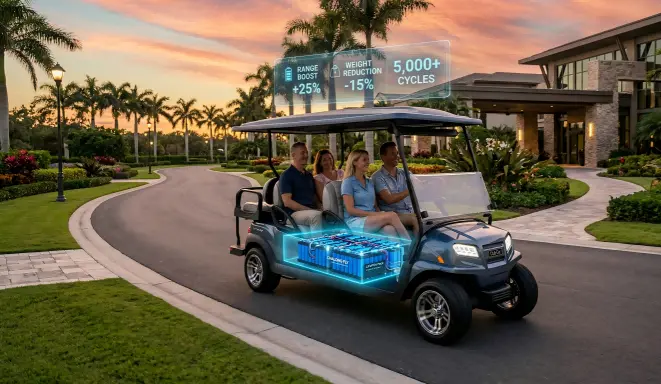
Whether you manage a resort fleet of neighborhood electric vehicles (NEVs) or utility carts for campus maintenance, sluggish acceleration and constant battery watering are major frustrations. As established in our Ultimate Guide to Industrial Motive Power Batteries, the shift to lithium is driven by hard financial and performance benefits.
1. Lead-Acid vs Lithium Golf Cart Batteries: Key Differences
Before evaluating the engineering metrics, it is crucial to understand the fundamental differences guiding this industry shift as an industry solution provider:
- Weight Difference: Lithium batteries are up to 70% lighter, which significantly reduces turf damage on golf courses and extends driving range.
- Lifespan Difference: Traditional lead-acid lasts 2-3 years (500 cycles); LiFePO4 battery systems last 7-10 years (5,000+ cycles).
- Maintenance Difference: Lithium requires zero watering, zero acid spill cleanups, and no terminal corrosion maintenance.
- Cost Difference: While the upfront CAPEX is higher for lithium, the Total Cost of Ownership (TCO) is up to 3x lower over a 5-year period.
| Performance Feature | Traditional Lead-Acid | Chalong Fly LiFePO4 Upgrade |
|---|---|---|
| Usable Capacity | Only 50% (To prevent permanent damage) | 100% (Full discharge with no damage) |
| Charging Speed | 8-10 hours (Requires full cycle) | 2-3 hours (Supports quick opportunity charging) |
🌍 Safety First: Resort & Passenger Certification
Safety is the primary concern for passenger LSEVs. Our lithium conversion kits use LiFePO4 chemistry, recognized as the most thermally stable option available. Unlike lead-acid, they do not emit explosive hydrogen gas during charging. All Chalong Fly systems comply with stringent international standards including IEC 62619, UL 2580, and UN38.3.
2. The Physics of Range: Weight and Rolling Resistance
LSEVs benefit massively from weight reduction. A standard 48V lead-acid battery bank weighs roughly 330 lbs (150 kg). A comparable Chalong Fly LiFePO4 lithium pack weighs only 40 kg (approx. 88 lbs). According to the physics of rolling resistance, a lighter vehicle requires significantly less energy to move.
(Rolling Resistance = Coefficient × Vehicle Weight | Less Weight = Extended Range)
Dropping over 240 lbs (110 kg) from your golf cart translates to faster acceleration, up to 30% more driving range per charge, and significantly less wear on tires and suspension components.
3. Golf Cart Lithium Upgrade Cost & Commercial ROI
When fleet managers evaluate the golf cart lithium upgrade cost, looking solely at the initial price tag is a mistake. The cost of a lithium golf cart conversion kit depends on battery voltage (36V / 48V / 72V), capacity (Ah), and fleet size. For most LSEV fleets, upgrade costs typically vary depending on configuration and application requirements.
💡 5-Year Cost Comparison Example (Per Cart)
Traditional Lead-Acid (48V)
- Initial Battery Cost $850
- Replacement (Year 3) $950
- Watering Labor (5 Yrs) $400
- Acid Cleanup/Maintenance $200
- 5-Year TCO $2,400
Chalong Fly LiFePO4 (48V 105Ah)
- Initial Kit Cost $1,650
- Replacement (Year 3) $0
- Watering Labor $0
- Acid Cleanup/Maintenance $0
- 5-Year TCO $1,650 (Save $750/cart)
Most fleet operators recover the investment within 18-24 months due to reduced maintenance, zero watering labor, and a lifespan that exceeds 5,000 cycles. For a fleet of 50 golf carts, saving $750 per cart yields $37,500 in total savings over 5 years. If you are planning a large-scale golf cart battery replacement, lithium is no longer just a technical upgrade—it is a commercial necessity.
Ready to Future-Proof Your Fleet?
As an industry solution provider, all Chalong Fly conversion kits include integrated BMS protection, comprehensive warranties, and plug-and-play designs to eliminate integration risks.
Club Car / EZ-GO / Yamaha compatible solutions