


Why Custom Industrial Battery Wire Harnesses Matter for Safety and System Reliability
Technical guide reviewed by CLF engineering team for industrial wire harness, cable assembly, and battery-related applications.
In industrial battery systems, cells often get most of the attention, but many field failures begin elsewhere: at the electrical connection point. Poor crimp quality, unstable contact resistance, undersized conductors, weak retention, or unsuitable sealing can all contribute to overheating, nuisance BMS alarms, voltage drop, and unexpected shutdown.
For OEMs, system integrators, EPC contractors, and fleet operators, the wire harness is not a secondary accessory. It is a critical part of the electrical architecture that directly affects current transfer, environmental protection, installation consistency, and long-term system reliability. This is especially important in motive power battery systems, UPS battery backup applications, and commercial and industrial energy storage systems.
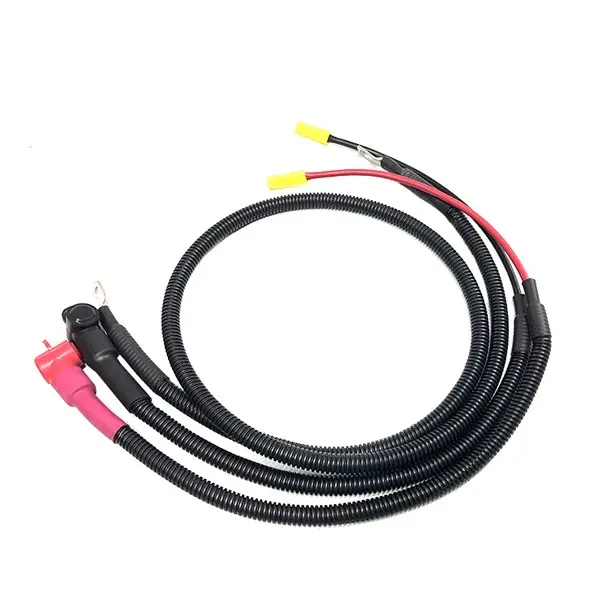
At Chalong Fly (CLF), we support custom wire harness solutions for battery systems, energy storage, motive power, RV, marine, industrial equipment, and a wide range of project-based cable and harness assembly applications. Depending on the project, harness assemblies can be configured with suitable connector platforms, matched cable gauge, sealing level, retention design, and terminal layout. For customers looking for integrated supply, these harnesses can also be coordinated with our OEM/ODM battery development services for custom industrial battery projects.
The Real Risk Behind Generic Battery Cables and Low-Quality Connectors
Many battery issues described as “battery problems” are actually connection problems. In high-current systems, even a small increase in resistance at the crimp, lug, terminal, or connector interface can produce localized heat. The problem may not be visible during initial testing, but under repeated loading, vibration, temperature changes, or long operating hours, it can turn into a recurring field failure.
Connector Overheating
If the terminal fit is poor or the connector system is not matched to the actual current path, heat can build up at the interface. This may lead to deformation, discoloration, unstable performance, or shutdown risk.
Voltage Drop Under Load
Undersized cables or unstable interfaces can create unnecessary voltage loss between the battery pack and the load. In lithium systems, that can trigger nuisance low-voltage alarms or reduced usable output.
Vibration-Related Disconnection
Floor cleaning machines, marine systems, RV systems, and other industrial applications expose the harness to continuous mechanical stress. Weak locking or poor strain relief can eventually lead to intermittent faults or complete disconnection.
Environmental Ingress
Dust, moisture, condensation, and corrosive environments can accelerate connection degradation if the sealing design, connector accessories, and routing details are not appropriate for the application.
Why Custom Harness Design Matters More Than Connector Brand Alone
In many projects, buyers focus first on the connector brand, but the real engineering question is whether the complete harness design matches the system. A good wire harness is defined by the full combination of cable sizing, terminal selection, connector family, sealing level, routing path, strain relief, and assembly quality.
That is why a professional supplier should not lock every project into a single connector brand. Instead, the harness should be configured around the actual requirements of the battery pack, inverter, charger, motor controller, PCS, RV power system, marine electrical system, or industrial equipment interface. In some cases, selected TE Connectivity solutions are appropriate. In other cases, Amphenol, Anderson, or customer-specified platforms may be a better fit.
This flexible approach is especially important in complex projects such as multi-cabinet storage systems, industrial retrofits, mobile equipment, or customers reviewing suppliers through a commercial BESS sourcing strategy. The more demanding the project, the less practical it is to rely on a one-size-fits-all cable set.
What a Proper Industrial Wire Harness Should Be Designed Around
A professional industrial harness should be designed around actual operating conditions rather than purchase price alone. In practical terms, that means validating more than the connector model number.
- Continuous current and peak current requirements
- Cable gauge and conductor construction matched to heat rise and voltage-drop limits
- Connector family and terminal type appropriate for the electrical and mechanical interface
- Sealing level suited to dust, splash, washdown, or condensation exposure
- Mechanical retention and strain relief for vibration-prone equipment
- Routing space and bend radius inside the battery, cabinet, vehicle, or equipment enclosure
- Power and signal integration where BMS communication and power lines coexist
- Assembly consistency and traceability across production batches
Why IPC/WHMA-A-620-Aligned Assembly Practices Matter
Even the right components can fail if the assembly process is inconsistent. For industrial wire harnesses and cable assemblies, workmanship control is just as important as material selection. Controlled stripping, stable crimping, insulation support, polarity verification, visual inspection, continuity testing, and resistance checks all influence real-world performance.
That is why CLF treats harness manufacturing as a process discipline rather than a simple accessory task. For OEM and project-based work, consistency in assembly helps reduce hidden defects and improves repeatability across batches. Customers evaluating engineering capability often review both quality control and smart manufacturing together when assessing long-term supplier reliability.
Common Failure Modes in Wire Harness Engineering
| Failure Mode | Typical Cause | System Impact | Recommended Engineering Action |
|---|---|---|---|
| Connector overheating | Excessive contact resistance, unsuitable connector selection, poor crimp quality | Heat build-up, unstable output, housing damage, shutdown risk | Review connector family, terminal compatibility, current margin, and crimp consistency |
| Voltage sag under load | Undersized cable, excessive cable length, unstable interfaces | BMS alarms, nuisance low-voltage trips, reduced output stability | Recalculate cable gauge, routing length, and allowable voltage-drop target |
| Intermittent field faults | Weak locking structure, vibration fatigue, poor strain relief | Random disconnection, difficult diagnostics, service complaints | Improve retention design, harness fixation, and vibration-oriented cable support |
| Ingress-related degradation | Insufficient sealing or unsuitable accessory selection | Corrosion, resistance growth, reduced service life | Select suitable sealed connector system and verify environmental compatibility |
| Production inconsistency | Manual process variation, unclear inspection criteria, weak labeling control | Batch variation, rework, field return risk | Apply controlled assembly workflow with defined inspection and traceability |
Applications That Commonly Need Custom Wire Harnesses
Custom harnesses are especially valuable when the electrical system must match a defined interface rather than function as a generic drop-in connection. Typical applications include:
- Battery and energy storage integration: project-based harnesses for battery systems, ESS, and related equipment interfaces
- Motive power equipment: selected applications such as floor cleaning machines, marine systems, medical carts, and RV systems
- Industrial equipment integration: cable and harness assemblies for defined electrical and mechanical interface requirements
- OEM/ODM development projects: customized routing, terminations, and interface matching based on actual project scope
If the project involves both the battery pack and the harness, it is usually more efficient to coordinate both together. This reduces the risk of mismatch between battery output, BMS architecture, inverter or controller input, and final cable layout. For this reason, many customers prefer working with a supplier that can support both wire harness engineering and OEM/ODM development within the same project flow.
How CLF Supports OEM and Project-Based Harness Requirements
CLF supports custom harness development based on the actual project interface rather than offering only standard cable sets. This can include cable length, conductor size, lug or connector type, branch layout, signal line integration, enclosure routing, and interface matching for inverters, motor controllers, chargers, PCS units, mobile equipment, and complete battery systems.
For customers developing industrial, motive power, energy storage, RV, marine, or general equipment products, this project-based approach is often more practical than sourcing the cable or harness separately. It simplifies coordination, reduces interface errors, and improves installation consistency at the final system level. Customers evaluating long-term supply models can also review our OEM/ODM service capability alongside our application-focused pages for energy storage systems, data center and IT room backup, and motive power applications.
Wire Harness Design Checklist Before Mass Production
| Design Item | What Should Be Confirmed |
|---|---|
| Electrical load | Continuous current, peak current, duty cycle, surge behavior |
| Cable sizing | AWG/mm², insulation type, allowable temperature rise, voltage-drop target |
| Connector selection | Current rating, mating structure, sealing, retention, serviceability, available space |
| Equipment interface | Battery output, inverter/PCS/controller input, terminal geometry, polarity control |
| Environment | Dust, water, salt, oil, vibration, temperature range, installation location |
| Mechanical layout | Routing path, bend radius, fixation points, abrasion risk, strain relief |
| Signal integration | BMS communication, CAN/RS485, sensor wiring, low-voltage branch routing |
| Production control | Labeling, continuity check, polarity verification, inspection criteria, traceability |
Need a Custom Wire Harness Matched to Your Project Requirements?
If you are developing a cable or harness project for ESS, UPS systems, motive power equipment, RV systems, marine applications, industrial equipment, or OEM products, CLF can support custom harness configuration together with project-based development. Share your current, connector, inverter, controller, or routing requirements and we can review the harness architecture with you.
Request a Custom Harness QuoteRelated Pages
Frequently Asked Questions
A standard cable set may not match the actual current, connector interface, routing space, vibration level, or environmental exposure of the equipment. Custom harness design helps reduce mismatch and improves installation consistency and long-term reliability.
No. CLF does not limit custom harness projects to a single connector brand. Depending on the application, we can work with selected connector platforms such as TE Connectivity, Amphenol, Anderson, or customer-specified equivalents.
Overheating is commonly linked to excessive contact resistance, unsuitable connector or terminal selection, inconsistent crimp quality, or conductors that are undersized for the actual operating current. The heat is usually generated at the interface where resistance increases.
Yes. CLF can support customized harness layout, cable gauge, cable length, termination style, connector type, signal integration, and branch configuration to match the electrical and mechanical interface of a specific application or equipment system.
Cable gauge directly affects resistance, voltage drop, and temperature rise. If the conductor is undersized for the real current and cable length, the system may experience unnecessary heat generation, reduced efficiency, or unstable operation under dynamic load.
Key items include current requirement, conductor size, connector family, sealing level, routing layout, retention method, polarity control, communication integration if needed, and production-side inspection and traceability requirements.
Conclusion
In industrial and equipment electrical systems, a wire harness should never be treated as a low-priority accessory. It is a functional part of the power path and a real contributor to system safety, installation quality, and field reliability.
The right custom harness solution is not defined by one connector brand alone. It is defined by whether the cable sizing, connector platform, retention design, environmental protection, routing layout, and assembly control are matched to the actual application. For OEM and project-based work, getting the harness right is often just as important as getting the main system right.