


How to Choose a LiFePO4 Battery Charger for Scissor Lifts and Aerial Work Platforms
A LiFePO4 battery upgrade for scissor lifts, boom lifts and aerial work platforms is not complete until the charger is selected correctly. For OEM equipment projects, charger voltage, charging current, charging profile, connector layout, BMS communication and machine-side wiring must be matched as one system.
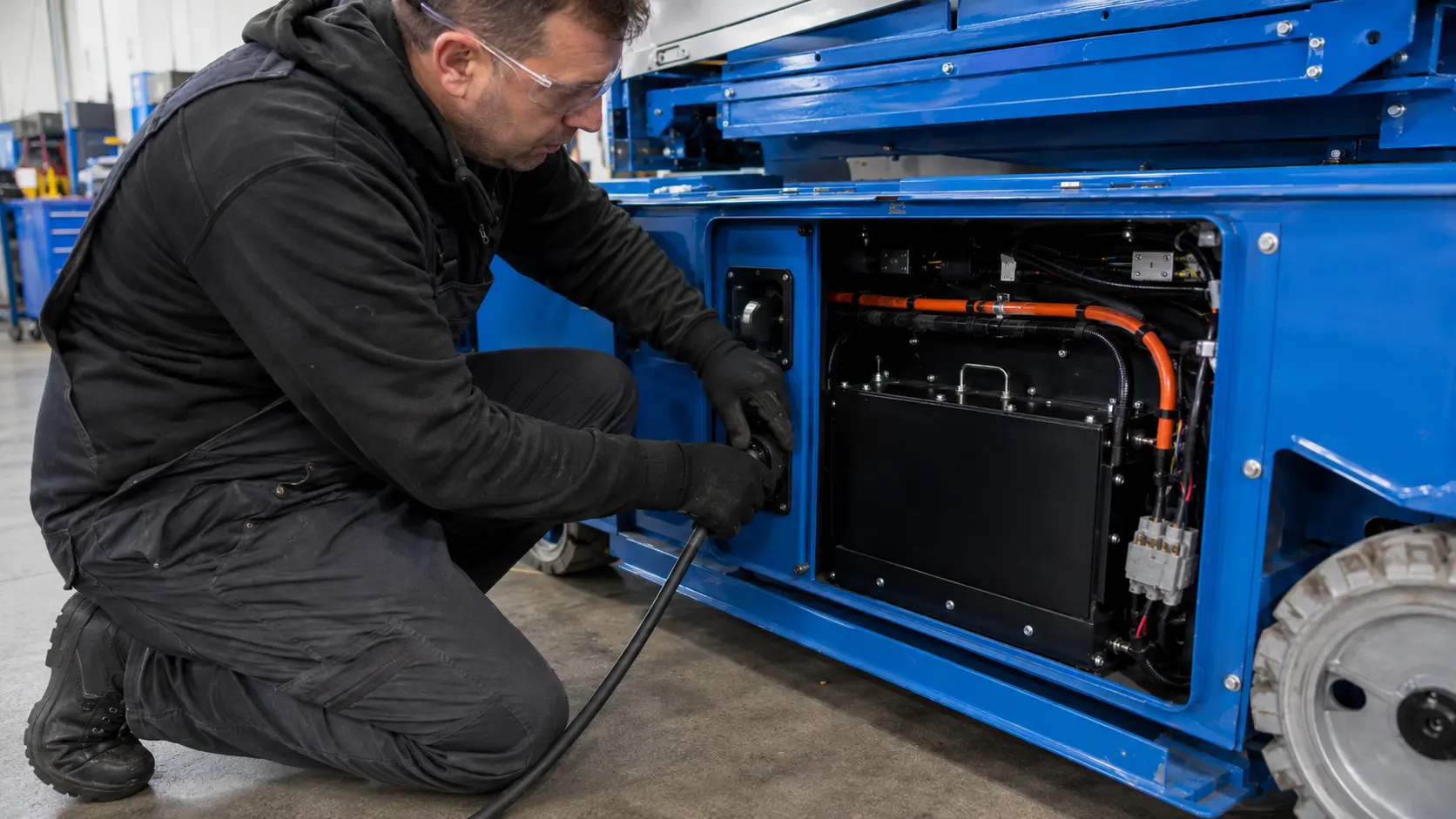
Why the charger matters in a LiFePO4 scissor lift battery upgrade
Many aerial work platforms were originally designed around flooded lead-acid or AGM batteries. When an OEM or fleet operator upgrades to LiFePO4, the battery pack may fit the machine physically, but the original charger is not always suitable for lithium chemistry.
The charger affects battery life, charging speed, safety behavior, fault reporting and daily operating efficiency. If the charging voltage is too high, the BMS may trigger over-voltage protection and disconnect charging. If the current is too low, charging takes too long. If the connector or communication logic is wrong, the machine may become difficult to use in real field service.
Chalongfly supports custom motive power battery solutions for industrial equipment, including LiFePO4 battery systems for scissor lifts and aerial work platforms.
Step-by-step checklist for choosing a LiFePO4 charger
A charger should not be selected only by looking at the output voltage on the label. For aerial work platform projects, the charger must be reviewed together with the battery pack, BMS, wiring harness, connector layout and the operating habits of the end user.
Confirm the LiFePO4 battery pack voltage
The charger output voltage must match the battery pack configuration. A 24V, 36V, 48V or 72V LiFePO4 system requires a different charging voltage from a lead-acid system with the same nominal voltage. For OEM projects, the battery voltage should be confirmed before charger model selection.
Choose a LiFePO4 charging profile
LiFePO4 batteries usually require a constant-current / constant-voltage charging profile with a suitable final voltage and current taper. A charger designed for flooded lead-acid or AGM batteries may include float charging or equalization logic that is not appropriate for LiFePO4 packs.
Set the charging current according to capacity and duty cycle
Charging current determines how fast the battery can be recharged. A higher current may reduce downtime, but it must be compatible with the battery cells, BMS, connector rating, cable size and thermal design. For rental fleets, warehouse shifts and daily maintenance cycles, charging time should be planned around real operating schedules.
Match charger behavior with the BMS
The BMS controls overcharge protection, temperature protection, current limits, cell balancing and fault behavior. If the charger does not match the BMS logic, users may experience charging interruption, incomplete charging, error codes or unnecessary protection shutdowns.
Confirm charging connector and machine-side wiring
The charging connector should be rated for the required current, easy to access, protected from vibration and suitable for repeated use. For OEM machines, the charging port, battery connector, charger plug, signal wires and service position should be designed together.
Test battery, charger and machine as one system
The final charger should be validated with the actual battery pack and machine. Testing should include normal charging, low-SOC charging, full-charge cut-off, temperature behavior, connector heating, machine standby state and operator charging workflow.
LiFePO4 charger vs lead-acid charger for aerial work platforms
| Item | Lead-acid charger | LiFePO4 charger | OEM recommendation |
|---|---|---|---|
| Charging curve | Often designed for flooded lead-acid or AGM charging behavior. | Uses LiFePO4-compatible CC/CV charging profile. | Do not assume the old charger can be reused. |
| Final voltage | May not match lithium pack voltage requirements. | Selected according to LiFePO4 cell configuration. | Confirm exact voltage with the battery manufacturer. |
| Float charging | Common in many lead-acid systems. | Usually not required in the same way for LiFePO4 packs. | Avoid inappropriate float or equalization settings. |
| Charging speed | Often slower, especially for deep-cycle lead-acid batteries. | Can support faster charging when cells, BMS and cables allow it. | Choose current based on capacity and real duty cycle. |
| BMS coordination | No lithium BMS coordination. | May need enable signal, CANBus, RS485 or charge control logic. | Define communication requirements before sample production. |
| Field risk | May cause incomplete charging, protection trips or battery faults. | Designed to match lithium battery protection and service behavior. | Validate charger, battery and machine together. |
Typical LiFePO4 charger voltage and current considerations
The exact charging voltage depends on cell configuration, BMS settings and battery manufacturer design. The following table is only a practical reference for OEM discussion. Final values should always be confirmed according to the actual battery pack design.
| Nominal battery system | Typical LiFePO4 configuration | Typical charger voltage reference | Selection focus |
|---|---|---|---|
| 24V | 8S LiFePO4 | About 29.2V for many full-charge designs | Compact scissor lifts, small MEWP equipment and lower-power platforms. |
| 36V | 12S LiFePO4 | About 43.8V for many full-charge designs | Medium equipment where battery size and charging time must be balanced. |
| 48V | 16S LiFePO4 | About 58.4V for many full-charge designs | Common industrial equipment voltage with strong OEM integration demand. |
| 72V | 24S LiFePO4 | About 87.6V for many full-charge designs | Larger platforms or equipment requiring higher power and lower current. |
For charging current, OEM buyers should avoid choosing the largest charger only for speed. A practical charger must match the battery cell charge rate, BMS charge current limit, connector rating, cable size, heat dissipation and daily work schedule.
Connector, wiring harness and BMS details that should not be ignored
A charger can only work reliably when the surrounding system is designed correctly. In aerial work platforms, the battery compartment is often narrow, exposed to vibration and used by operators who need simple daily charging.
Chalongfly can also support battery wiring harness design and custom cable assembly integration for OEM lithium battery projects.
On-board charger or off-board charger?
Both charger layouts can work for scissor lift and aerial work platform projects. The better choice depends on equipment structure, fleet maintenance habits, charging environment and OEM cost targets.
On-board charger
An on-board charger is installed inside the machine. The operator only needs to connect AC input to the machine-side charging port. This design is convenient, but it requires reserved mounting space, heat dissipation and safe cable routing.
- Convenient for daily charging
- Cleaner operator workflow
- Requires machine-side space and thermal design
- Good for OEM integrated platforms
Off-board charger
An off-board charger is separate from the machine and connects to the battery or charging port during charging. It may reduce machine-side complexity and make charger replacement easier, but connector durability and charging station management should be considered.
- Easier charger replacement
- Lower machine-side integration complexity
- Requires reliable charging connector design
- Common for fleet and service environments
Common mistakes when choosing a scissor lift LiFePO4 charger
Charger mismatch can cause more field problems than the battery cells themselves. The following issues should be avoided before sample production and fleet deployment:
- Reusing the original lead-acid charger without checking the charging curve.
- Choosing a charger only by nominal voltage, not by exact LiFePO4 charging voltage.
- Selecting charging current without checking BMS charge current limits.
- Ignoring connector current rating, pin layout and long-term plug-in durability.
- Failing to test charger cut-off behavior with the actual BMS.
- Leaving no space for safe charging cable routing inside the battery compartment.
- Not defining whether communication or charging enable logic is required.
Information to prepare before requesting a charger and battery quote
To design a reliable LiFePO4 charging solution for aerial work platforms, OEM buyers should provide the following information together with the battery requirements:
- Machine type: scissor lift, boom lift, MEWP or other lifting equipment.
- Existing battery voltage and capacity, or target LiFePO4 voltage and capacity.
- Battery compartment size, charger position and charging port location.
- Required charging time or expected daily working schedule.
- Preferred charger type: on-board charger or off-board charger.
- Connector model, cable length and machine-side wiring layout if available.
- BMS communication requirements, such as CANBus, RS485, enable signal or simple charging control.
- Sample quantity, testing plan and estimated production volume.
Need a LiFePO4 battery and charger solution for scissor lifts?
Chalongfly provides OEM/ODM LiFePO4 battery pack development for scissor lifts, boom lifts and aerial work platforms. We can support battery pack design, charger matching, BMS configuration, charging connector layout, wiring harness integration, sample validation and production support.
- 24V / 36V / 48V / 72V LiFePO4 battery pack customization
- LiFePO4 charger matching and charging profile review
- BMS charge current, protection and communication configuration
- Battery connector, charger connector and wiring harness integration
- OEM/ODM support for aerial work platform manufacturers and fleet upgrade projects
FAQ: LiFePO4 battery chargers for scissor lifts and aerial work platforms
Can I use a lead-acid charger for a LiFePO4 scissor lift battery?
It is not recommended unless the charger output voltage and charging profile are confirmed to match the LiFePO4 battery pack and BMS. Many lead-acid chargers use charging logic that is not suitable for lithium batteries.
What charging profile does a LiFePO4 battery charger need?
A LiFePO4 charger usually uses a constant-current / constant-voltage charging profile with a final voltage matched to the battery pack configuration. The charger should not use inappropriate equalization or float charging settings.
How do I choose charging current for an aerial work platform battery?
Charging current should be selected according to battery capacity, required charging time, BMS charge current limit, connector rating, cable size and thermal behavior. A faster charger is not always better if the system is not designed for it.
Does the charger need CANBus or RS485 communication?
Not every system requires communication, but some OEM machines use CANBus, RS485 or enable signals to coordinate battery charging, SOC display and fault reporting. Communication requirements should be defined before sample production.
Can Chalongfly provide battery pack, charger and wiring harness integration together?
Yes. Chalongfly can support LiFePO4 battery pack design, charger matching, BMS configuration, charging connector layout and wiring harness integration for scissor lifts and aerial work platforms.