


Top 5 Causes of Cable Failure in Automation Machinery (And How OEM Overmolding Fixes Them)
In the world of Industry 4.0, unplanned downtime is the ultimate enemy. While engineers spend countless hours optimizing PLC logic and servo motor performance, one of the most common—and preventable—causes of automation failure is often overlooked: the humble cable assembly.
A compromised connection can lead to signal loss, false sensor readings, or complete power failure, grinding a million-dollar production line to a halt. In this article, we’ll explore the top 5 reasons industrial cables fail and how adopting Industrial Cable Assemblies with OEM custom overmolding can permanently solve these issues.
The Hidden Cost of Substandard Connectivity
Standard off-the-shelf cables are rarely designed for the brutal realities of a factory floor. They lack the mechanical robustness required to survive continuous motion, exposure to harsh chemicals, and constant vibration.
Top 5 Causes of Industrial Cable Failure
1. Extreme Vibration and Mechanical Stress
Heavy machinery, CNC routers, and stamping presses generate continuous low-frequency vibrations. Over time, this mechanical stress travels down the cable and concentrates at the connector pin joints. Without proper strain relief, the solder or crimp joints will eventually fracture, causing intermittent connection drops.
2. Chemical, Oil, and Moisture Ingress
In automotive manufacturing or CNC machining, cables are frequently exposed to cutting fluids, hydraulic oils, and high-pressure washdowns. Standard plastic connector boots have microscopic gaps. Once moisture or oil bypasses the connector shell, it corrodes the metal contacts and causes short circuits.
3. Repeated Bending and Torsional Fatigue
Robotic arms and automated guided vehicles (AGVs) require cables to flex millions of times throughout their lifespan. If the bend radius is too tight or the cable lacks torsional flexibility, the internal copper conductors will snap, even if the outer jacket looks perfectly intact.
4. Inadequate Strain Relief at Connector Junctions
When operators accidentally trip over a cable or pull the cord instead of the connector body to unplug it, the physical pulling force transfers directly to the delicate internal wiring. Standard heat-shrink tubing is often insufficient to absorb this kinetic energy.
5. Substandard Assembly and Non-Compliant Crimping
Poor workmanship is a silent killer. Inconsistent crimp heights, loose terminal seating, or improper wire stripping can lead to high resistance, heat generation, and eventual failure. This is why adhering to strict manufacturing standards is non-negotiable.
How OEM Custom Overmolding Solves These Problems
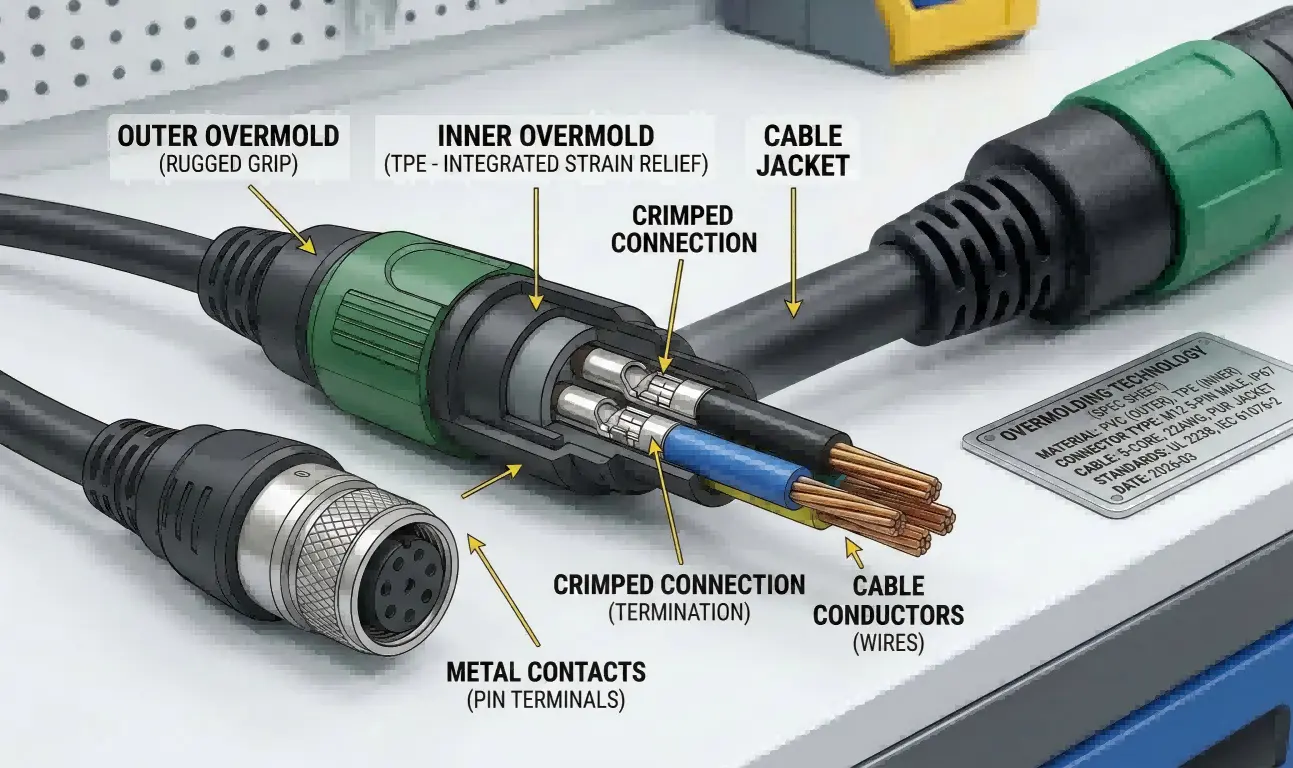
As seen in the cross-section structural analysis above, the ultimate solution to these mechanical vulnerabilities is Overmolding. It is a precision injection molding process where a durable resin (such as TPU, PUR, or PVC) is injected directly over the cable and connector junction, fusing them into a single, seamless component.
- 360-Degree Strain Relief (Inner Overmold): The inner TPE layer acts as a robust shock absorber, preventing the cable from bending sharply at the exit point and transferring pulling forces away from the internal pins.
- Unbeatable IP67/IP68 Sealing: Because the resin bonds chemically with the cable jacket and connector shell, there are zero gaps. It effectively locks out moisture, oils, and industrial dust.
- Tamper-Proof Durability (Outer Overmold): The rugged outer grip ensures the connector cannot be unscrewed or tampered with by field operators, protecting the integrity of the internal crimped connections.
The Chalong Fly Advantage: IPC-620 Certified Assemblies
At Chalong Fly, we engineer interconnect solutions that refuse to fail. Whether you need ruggedized sensor cables, high-flex robotic harnesses, or complex power distribution looms, our Custom Cable Assembly services are designed for the harshest environments.
We manufacture strictly to IPC-WHMA-A-620 standards, ensuring 100% continuity testing, precise crimp validation, and custom overmolding tooling tailored precisely to your mechanical constraints.